Another Monday Message Board. Post comments on any topic. Civil discussion and no coarse language please. Side discussions and idees fixes to the sandpits, please.
Like millions of Australians, I shop at Coles. I’m not as careful as I should be, but I try to buy things advertised as being discounted, or on special. But after following a recent case before the federal court, I’ll be checking my old receipts before accepting such claims. In particular, I’ll be avoiding “Down Down” promotions. On the evidence before the court, such promotions are routinely used as a way of implementing price increases.
The facts of the case are simple and apparently uncontested. One example is particularly striking. Over a period of nearly a year, Coles offered a 1.2kg loaf of Nature’s Gift wet dog food for $4. Then, for seven days, the price rose by 50% to $6. On the eighth day the price was set at $4.50, more than customers had been paying for all but seven of the previous 303 days, with Coles labelling the product “Down Down”.
The only unusual feature of this path to higher prices was the short duration of the large increase. According to Coles’ lawyers, the more common pattern was to raise the price for six to 12 weeks, then partially reverse the increase and advertise “Down Down”. As the evidence regarding deals with Arnott’s makes clear, this strategy is planned in advance as a way of raising prices without upsetting consumers. In their defence, Coles claimed that Woolworths’ “Prices Dropped” program (the subject of a separate ACCC case) was even worse.
More broadly the defence was that consumers were incapable of understanding the many complexities of pricing decisions. But most of us are capable of understanding the idea that taking prices two steps up then moving them one step down still leaves them higher. Whatever the outcome of the court case, it’s hard to believe that Coles will be able to get away with “Down, Down” promotions in future, even if they are genuinely reducing prices.
In the long run, then, it seems as if this kind of sharp practice should be self-defeating. The banks, for example, have spent years trying to shake off the bad reputation they built up for hidden fees and charges in the years leading up to the financial services royal commission.
Woolworths and Coles are big companies that plan to stay around for a long time. Could not one or both of them commit to a policy of truthful advertising and stand by it long enough to establish a reputation that customers could trust?
This hasn’t happened – with supermarkets, or telecoms, or banks or anywhere else, at least in the absence of comprehensive public shaming driven by government action. But why not?
One explanation, apparent from the evidence in the Coles case, is that no one wants to be the first to move. Given the short-term pressure that decision-makers are under, it’s easy to imagine that any proposal of this kind will be put in the too-hard basket and left there.
Another possibility is that distrust is so widespread that no single company can break the pattern. The era of neoliberalism has certainly strengthened this distrust. There was a time when used car dealers were famously untrustworthy but financial institutions were pillars of probity. Today, when buying a second-hand car, the biggest risk is not that the speedo will be wound back but that you will be sold a loan with deceptively high interest. In this context, you just assume everyone is lying.
The final, gloomy, hypothesis is that Coles’ lawyers are right, and that we are proving the wisdom of HL Mencken’s observation that “No one in this world, so far as I know … has ever lost money by underestimating the intelligence of the great masses of the plain people” (put more succinctly by PT Barnum as “there’s a sucker born every minute”).
Perhaps we are simply incapable of resisting an apparent bargain, even when we know there’s bound to be a catch. For years, we all fell for the illusion of items priced at $9.99 or similar, rather than the honest price of $10. Partly because of the digital economy, this particular trick seems to have faded away.
But the same digital economy has far nastier tricks in mind for us. The trickery of “Down Down” seems childish compared to the wonders of personalised pricing, where sellers set a price specifically aimed at being the maximum you are willing to pay, and precisely when you are primed to buy. The only solution, it appears, is to build your own AI agents, to trick the company algorithm into seeing you as a desirable customer
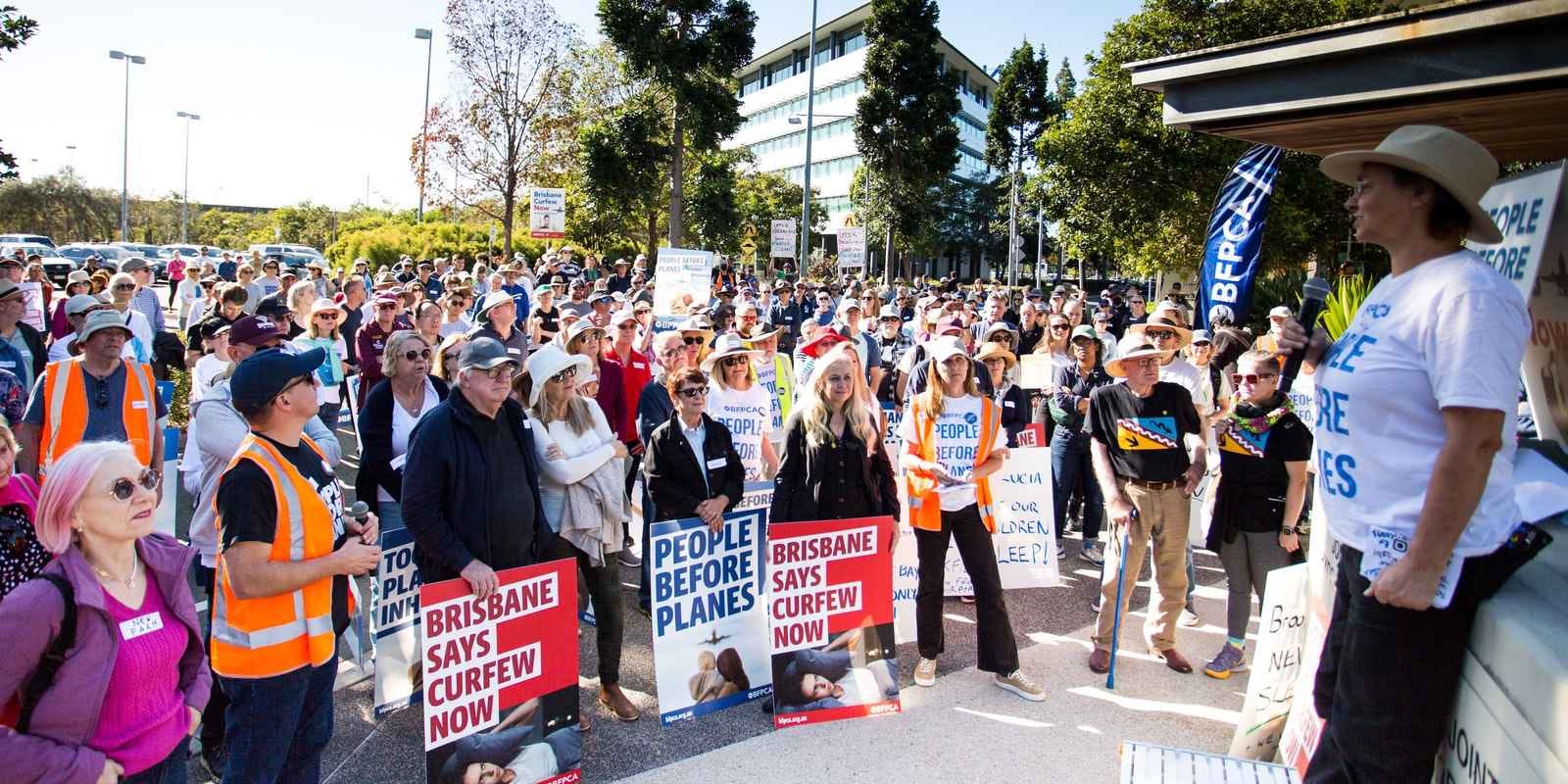
I spoke last week at a meeting organised by the Brisbane Flight Paths Community Association to demand a curfew on planes flying over Brisbane. These are mostly either international flights (subsidised by the state government) to promote tourism) or overnight freight, for which there is a fairly modest convenience benefit
By contrast, the adverse health effects and sleep disruption associated with night-time airport noise have huge costs, running into the billions, whether you estimate these directly or via effects on land values.
Unfortunately, this cuts very little ice with our political class, most of whom are frequent fliers and only a few of whom are among the hundreds of thousands of Brisbane residents affected by noise. Only the Greens have stood on the side of residents, and only when voters desert Labor en masse will they win enough seats to influence policy here.
Not long after Trump took office, I observed that the status of the US as the “indispensable nation” could not be sustained. A year later, the US, considered strictly as a state actor, is already dispensable and has, in fact, been largely dispensed with, by Europe in particular. The standing ovation given to Rubio in Munich recently (made almost unavoidable when his retinue jumped to their feet in Stalinesque fashion) should not obscure the fact that almost no one interpreted it as anything more than a politer restatement of Vance’s tirade a year ago. At that time, Europe needed to keep Trump on-side to prevent a sudden collapse in support for Ukraine and to avoid an all-out trade war.
None of that is particularly relevant now. Europe (include Ukraine) has held Russia to a standstill for a year despite the complete cessation of US military aid. The US is still relevant as an arms exporter and as a patchy supporter of sanctions against Russia, but that’s about it. Trump has turned his attention to his desire to rule the Americas from Nunavut to Tierra del Fuego, as well as returning to the forever wars of the Middle East.
Another Monday Message Board. Post comments on any topic. Civil discussion and no coarse language please. Side discussions and idees fixes to the sandpits, please.
Another Monday Message Board. Post comments on any topic. Civil discussion and no coarse language please. Side discussions and idees fixes to the sandpits, please.
One of the strangest features of the Australian political system over the last 80 years or so has been the permanent coalition between the Liberal and National (formerly Country) parties. It sometimes puzzles foreigners – I remember an American observer saying that the prevalence of coalition governments here was an indicator or political instability. And it takes different forms in different places. At the national level, until two weeks ago, there was a standing coalition agreement even when in opposition (this dates back to the 1970s, I think). There’s a similar arrangement in NSW and Victoria, but in WA the two parties operate independently. At the other extreme are merged parties – the LNP in Queensland [1] and the CLP in the NT. In SA, Tasmania and the ACT there’s no separate country party.
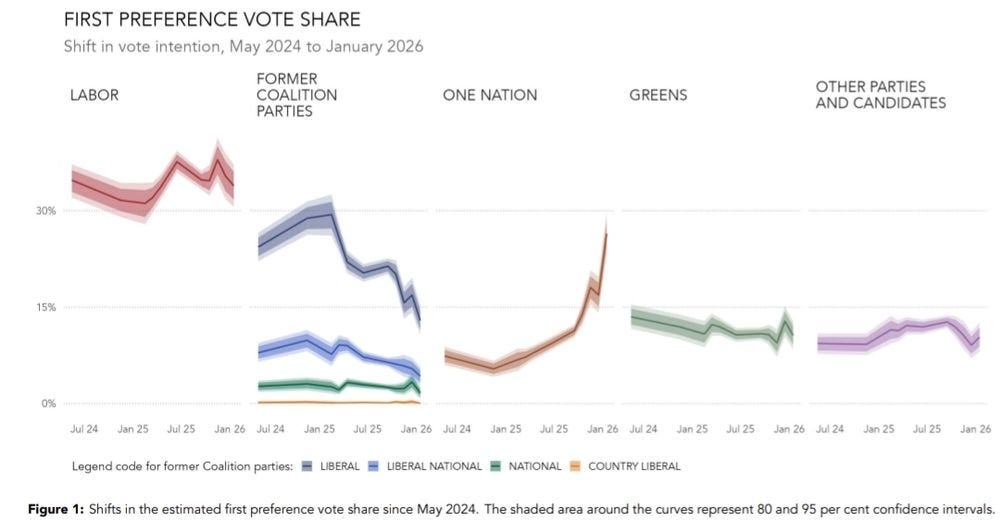
Until now, the usual convention in reporting polling results has been to aggregate these parties into a single grouping reported as “LNP” or “Coalition”. But the breakup of the federal coalition means it is better to report them separately as four groups: Liberals, Nationals, LNP and CLP. Combined with the resurgence of One Nation this yields the starting possibility that the Liberals (as well as the other three) may soon have polling support below 10 per cent.
This graph from Redbridge (kindly provide by Ben Messenger) illustrates the point. The Liberals alone were polling at nearly 30 per cent a year ago, before the 2025 election disaster, but are now barely in double digits
Regardless of the precise number, these results have dire implications for the project of a moderate centre-right urban Liberal party, split off from the rightwing and far-right majority and aiming to making some kind of common cause with community independents. Such a party would command less than half of the Liberal party’s supporters or maybe 5 per cent of the population (plus whatever it could draw from the Queensland LNP). It would start with seven or eight members in the House of Representatives, along with some Senators who would be unlikely to get a quota in a Senate election.
Of course, just about anything could come out of the current chaos. For example, a merger of One Nation and the Nationals could easily become the main opposition party. But on Hanson’s track record it probably wouldn’t last long. And even if it endured, the chance of such a party actually winning would be small. Hanson’s permanent support base (embittered middle-aged and older low-education regional voters) is not only small, but so different from the actual majority of Australians to whom they refer as “inner-city elites”.
More likely is continued division on the right, with the remaining urban seats being picked off by Labor and the independents. The dreary implication is that Labor will continue to roll up big majorities even as its primary vote falls to 30 per cent or less. And as long as Albanese is leader, those majorities will not produce any significant policy change, let alone the radical transformation this country needs to respond to the challenges of global heating, Trumpism and the information economy.
fn1. I got in trouble 20 years ago or so for a jokey post predicting that there would be no more Liberal PMs because the Libs and Nats had to merge. Happened in Queensland, but not nationally.
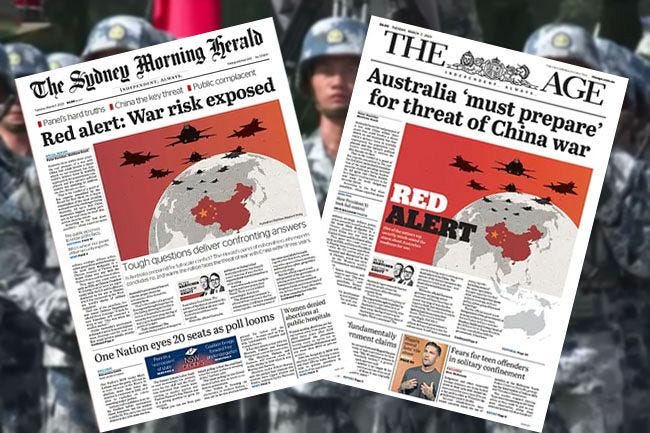
Back in March 2023, the Nine Papers ran a series of articles, entitled Red Alert, based on the claim of an “expert panel” that we should be ready to fight a war with China, within three years. With only a few weeks to go before the third anniversary of the series, the prediction is not looking good. Not only has there been no war, but relations between Australia and China are friendlier than they have been for years, going back at least as far as Turnbull’s prime ministership.
Where did Nine go wrong, and what lessons can we learn? The first, and most important error was the assumption that the PRC government could, if it chose, launch an invasion of Taiwan which would succeed in the absence of intervention by the US and its allies.
This claim was widely accepted in the US at the time, at least until analysts absorbed the lessons of Russia’s invasion of Ukraine. The most commonly proposed date was 2027, the “Davidson window” based on unverified claims that Xi Jinping wanted an invasion, or at least the capacity to undertake one, by then.
But as I argued at the time , the claim disregarded the history of seaborne invasions, which is mostly one of failure. The one success on a comparable scale, the D-Day landings in Normandy, required a preponderance of forces massively greater than that available to the the PRC.
This historical analysis was reinforced by the crushing defeat of Russia’s much-feared (before 2022) Black Sea Fleet. The anticipated assaults on ports like Odesa not take place, and the Fleet played almost no role in the grinding and brutal battle for Mariupol. Worse, beginning with the sinking of the Moskva early in the War, Ukraine, with no naval forces at all, drove Russia’s Navy off the sea entirely, forcing it to seek shelter in faraway Russian ports, but not safe even there.
All of this evidence was available at the time Red Alert was published. The authors could also have looked at China’s failure to undertake any serious preparation for a seaborne landing. China has only a dozen or so modern amphibious assault ships with a combined capacity of perhaps 10 000 troops. And, despite a massive buildup of naval forces generally, the PLA Navy is only adding one or two such ships every year. The supposed backup, dual use civilian ferries, is also proceeding slowly. A recent exercise involving twelve such ships falls far short of what is required for a serious threat
Meanwhile Taiwan is learning the lessons of the Ukraine war. Despite the resistance of the defence establishment (and particularly the navy), Taiwan is shifting expenditure towards the acquisition of missile and drone defences that would make any invasion attempt a catastrophic risk. Taiwan is shifting from reliance on imported US anti-ship missiles, such as the Harpoon to the domestically produced Hsiung Feng III with a range of 400km (considerably more the the width of the Taiwan strait).
As a result of these developments, most analysts (though not the Nine papers) have given up on the Davidson window and started talking about alternatives to invasion, such as a blockade or the more nebulous “quarantine” [1]. These won’t work but have kept the idea of imminent conflict going.
The big unforeseen development since 2023 was the re-election of Donald Trump and his shift in focus to plans to dominate the Americas (the “Donroe doctrine”). It is now pretty clear that Trump would be unwilling to commit US forces to defend Taiwan. China’s military and naval buildup, while not very useful for an invasion of Taiwan, has made such a commitment very risky.
For Australia, the withdrawal of a US commitment to defend Taiwan makes the prospect of war with China even more remote. The operating assumption, and the basis for AUKUS, has been the idea that Australian forces would serve under US command. In the absence of US participation, all we could offer Taiwan in the (remote) event of a war with China is the kind of assistance we’ve given Ukraine – thoughts, prayers and some surplus military equipment.
The UK has drawn the same lesson, scaling back the Indo-Pacific operations (the so-called “tilt the Asia Pacific) which provided the strategic rationale for its role in AUKUS, and abandoning it last permanent base ”east of Suez”. . At this point the only UK interest in AUKUS is to get as much Australian money as possible to support its submarine industry.
I will be surprised and impressed if Nine revisits this failed forecast, and even more so if the result is a change in the coverage of our relations with China and the US.
fn1. What I’ve called the Clayton’s version – the blockade you have when you’re not having a blockade.
Another Monday Message Board. Post comments on any topic. Civil discussion and no coarse language please. Side discussions and idees fixes to the sandpits, please.
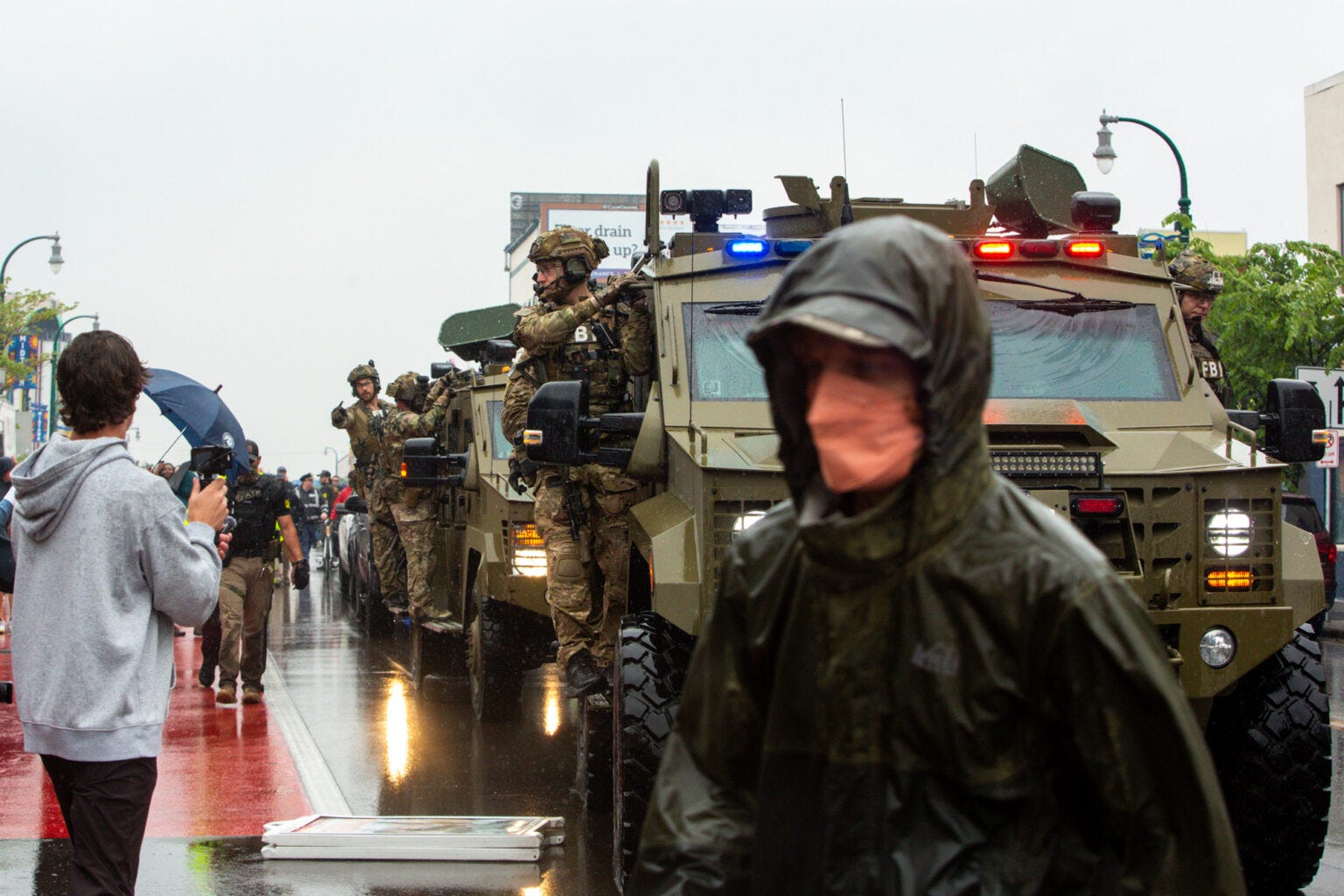
Ever since it became evident that Trump was likely to be re-elected, I’ve been among the most pessimistic of commentators on the likely course of US politics (most recently here for example). I’ve also been nowhere near pessimistic enough. I assumed that Trump would follow the course of dictators like Putin and Orban, gradually eroding freedom and making his own power permanent. Instead, he’s gone most of the way inside a year.


 John Quiggin